My first visit to a war cemetery was in 1969 while on a school trip to Belgium as a 16 year old youth. I had seen war films and had just started to read the history of WW2. My father signed up under age into the Royal Navy in the last war and used to relate tales of his experiences in the Far East, North Africa and Normandy. I thought I knew it all, but the impact of seeing row upon row of headstones stretching to the horizon at Tyne Cot military cemetery just below the ridge at Passchendaele to the east of Ypres confounded me.
Each headstone represented a life lost, but not wasted. I made some photographs with my trusty Practica camera and printed up a 16×12 when I came home. I remember bending the printing paper as I exposed to get a blurry effect to give the impression that the headstones stretched to infinity. I still have that print and the negatives neatly filed away. I was hooked.
Many years later I accompanied a group of WW1 veterans with the author Lynn McDonald back to the battlefields of northern Europe while working for The Times.
I became the de facto war graves photographer. When I joined the Independent I put forward once or twice a year a story from Northern France or Belgium, visiting veterans, desecrated cemeteries and burials of newly found bodies.
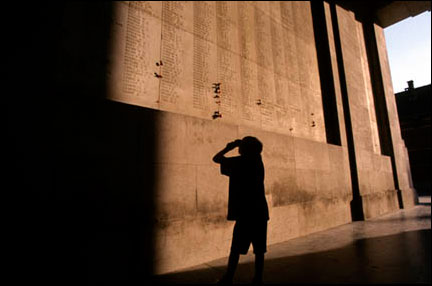
Menin Gate, Ypres, Belgium: over 54,000 names of soldiers who have no known final resting place are engraved on the walls of the memorial.
Imagine my delight when five years ago the press officer at the CWGC, Peter Francis, asked me if I was interested in doing a book about the Commission. We started off slowly, a few days at a time, to make sure that we were both happy with the results. Without Peter’s vision and his confidence in me, this project would have been a non starter.
My first work was shot in the bleak winter of 2002. Black days with brooding skies, extremely melancholic and very much my preferred way of making images. The days were short, so no time to hang around for perfect photographic conditions, I just shot what I saw as if working for a newspaper. There wasn’t a lot of colour…or joy. I was making pictures for me and not the client. I was trying to be photographically clever without fully understanding the remit of the Commission.
I did some more work for the CWGC over the next few months and the book idea was always discussed but never commissioned. The whole project needed a kick. Money of course was always going to be an issue. The CWGC operate worldwide in over 150 countries in 23,000 locations caring for the memory of 1.7 million fallen soldiers. I could see a lifetime of work ahead.
Then at the beginning of 2006 we got the green light. A workable budget, a publisher and a writer co-ordinator in Julie Summers. She had experience in organising exhibitions with the Henry Moore Foundation and had written books on Shackleton and the POW’s at the River Kwai. We were off.
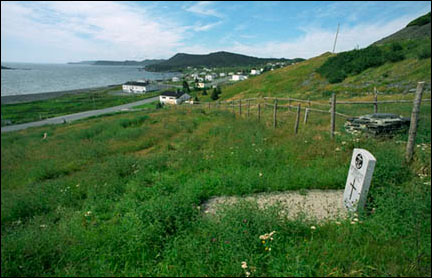
Ferryland Old General Cemetery, Newfoundland, Canada: the lone grave of engine room artificer Norman Benner, died 21 June 1942
There was a condition though. Please, I was asked, can we have some images that show off our cemeteries in the best possible light. The CWGC employ hundreds of gardeners worldwide and I was asked to show off the fine horticulture as much as possible. I was very happy to oblige and so started a trip around the world chasing the seasons to get the best of each and every location.
It’s not every day, if ever, that a client asks you to spend the best part of six months traveling around the world for them. This was a one off and one that required military planning.
[page]
First off was ten days in Gallipoli, Turkey, where the ANZAC troops as well as British and French soldiers fought and died as they tried to force the Dardanelles. Churchill has a lot to answer for.
There are over 30 memorials and cemeteries on the Gallipoli peninsular, spread along the battlefield front lines. The first couple of days were what I used to call ’Kodachrome’ days, bright blue skies and crisp light on the memorials.
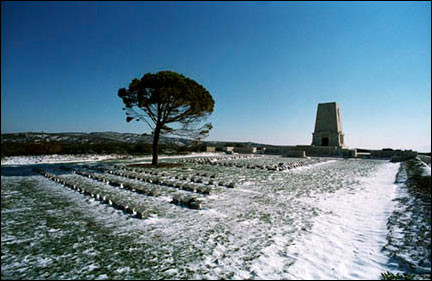
Gallipoli, Turkey: Lone pine cemetery on the ridge above Anzac Cove.
Then it rained. Rain, rain, rain. Horizontal, upright and just plane downpour. Then it snowed. A blizzard, two feet deep, black ice, the works. My car slid into a Turkish frontline trench. So, I had thirty plus locations which in the end were shot three times each, almost.
Plus, I was attacked by a snake, it’s fangs went through my trousers and then I was chased by a pack of wild dogs. Honest, there were at least 18 of them, foaming, teeth gnashing, salivating, baying for my blood as I ran at a rapid rate of knots down the road before jumping into my hire car and putting the central locking on. Do dogs have thumbs?
Gallipoli was an awakening of what was to come. Exotic locations but essentially the same. Memorials and cemeteries. How to tell them apart, how to make each location individual ?
I approached each cemetery the same. I would arrive and walk in through the gate; I would look and photograph the most immediate aspect of the location that appeared in that first instance. It may be the way the shadows fell or a detail or an inscription. It was so important that it was the location that spoke and not my photography that prevailed.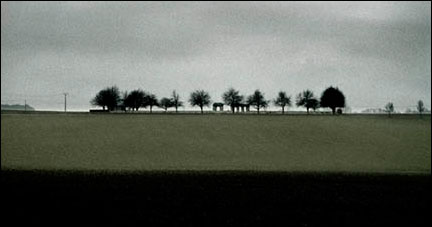
Caterpillar Valley Cemetery, The Somme
Then to Europe. Normandy via the Somme to Loos and Mons. To Ypres in Belgium and on to Arnhem and down through northern Germany. To the high peaks of the Asiago Plateau in northern Italy where the snows had just melted and down the Adriatic coast of Italy following in reverse order the battles of the Indian and Canadian forces and then across the Apennines to Cassino. Then to follow the slow trudge up the left side of the Italian leg via Orvieto and Florence. The penultimate stop was Marseilles, where the cemetery was locked up because of vandalism. I had to climb the gates as the local CRS flics patrolled nearby.
[page]
The last stop of the 6 week European leg was poppy hunting in the Somme area. My client had said that they weren’t that interested in ‘Poppy’ pictures, wreaths and the like, as that was more what the British Legion was about. OK , fine. But I wanted a poppy picture, I wanted a field of poppies with a cross of sacrifice in the background. Piece of cake, everyone knows that the battlefields of northern France are filled with poppies, don’t they !
Ahem, not the week before the 90th anniversary of the battle of the Somme. The French authorities in their infinite wisdom had cut back the grass verges throughout the entire Somme area, security, neatness, who knows, but that is where the poppies were in abundance. My heart sank as I drove around looking for a poppy, for a second I even thought of buying some silk flowers, just for a second.
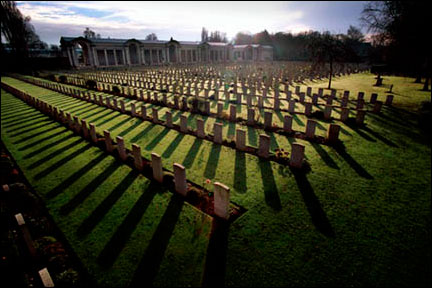
Arras Memorial and Faubourg d’Amiens Cemetery.
The next morning I looked out of my hotel window and it was if someone had poured their entire red paint pallet onto a nearby field right next to the CWGC cemetery at Rancourt. I dashed around like a photographer possessed, making dozens, hundreds of images of poppies and the Cross of Sacrifice, fearful that at any moment some giant poppy cutting machine would come and do for them.
I had the cover for the book.
The Middle East was next. Malta, Crete and Egypt. Malta was hard. The landscape is hard, the light likewise. Crete was one location at Suda Bay. In Egypt I had a member of the Commission staff in Michel Menoir, who works in the accounts section, as my driver , fixer and friend. We managed to cover Alex and El Alamein in three days. Which is far quicker that even Monty or the Desert Fox could have hoped for.
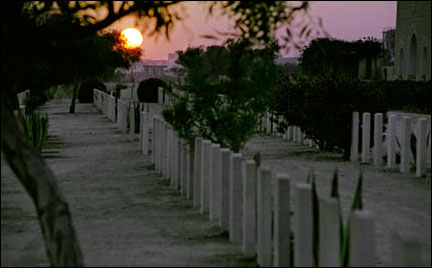
El Alamein War Cemetery, Egypt.
El Alamein is quite spooky at dusk. The sand dust creates a mist which forms a veil as the sun sets. The desert plantings would catch the last rays of the setting sun and that is where my images were. Cairo and Suez followed with a side trip to the Pyramids and the Egyptian Museum. It was all so fast, Crete was becoming Malta becoming Suez. I was tired and confused.
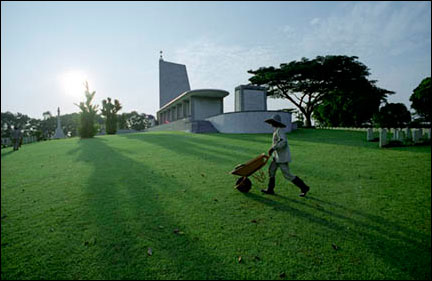
Kranji Cemetery, Singapore.
Home for some R&R and post production. I was shooting film so there was an inordinate amount of scanning to do.
No sooner was I home then I was sent off on the next leg. Singapore, Thailand and Hong Kong, all within 10 days. In Singapore I met up with my friend ex-Indy staffer John Voos who is now with Reuters as a Global Picture editor ( now back in London ). I wanted to catch the early morning light so I slept in my Mercedes taxi waiting for the dawn to photograph Kranji cemetery. Thailand and the two cemeteries at the Kwai crossing followed. Hong Kong was busy.
[page]
A quick flip back to blighty to drop the film off at a lab and a turn round back to India. It was less expensive to fly back from Hong Kong to London and then re trace my steps back to Delhi than go direct. Global footprint, pah!
India was hot and busy and beautifully disjointed. I had a driver to take me to a cemetery, out of the centre. I asked if he knew the way. Yes, of course. Three hours later after a breakdown and running out of fuel we found the location with the help of some striking student doctors.
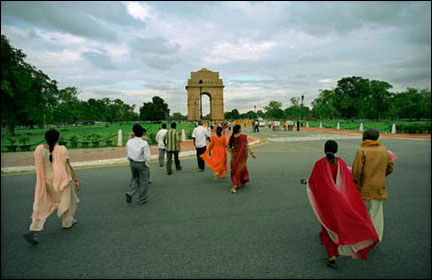
Deli Memorial, India Gate, at the end of Rajpath.
India Gate is a huge Lutyens designed memorial in the centre of Delhi. I tried photographing during the day but the light was so hard and bright that all detail was lost. I returned an hour before dusk. I made a decent frame from the back of my Tuk tuk and then followed a family making an evening visit, saris wafting as the women walked.
Mumbai makes Delhi seem almost at peace. The Memorial Hall is in the Seaman’s mission in the old dock area. I don’t think many visitors come here. Poona was next, up in the hills. A month before my arrival the cemetery was 10 feet under water and a lot of damage was done. The headstones were green with algae. So a little PS work was done here.
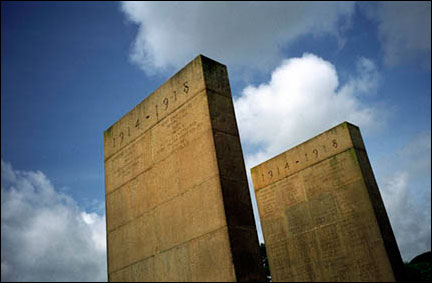
Kirkee War Cemetery, Poona, India.
Home again to do some editing and post production before heading off to Ottawa and Newfoundland. In the whole of North America, Canada and the USA there are over 3000 CWGC headstones and memorials. Some are so remote, such as in Saskatchewan that it take days off road to find them, others are in Beechwood Military Memorial Cemetery in Ottawa.
The most moving though are the single graves high on the hills above the sea in remote Newfoundland. My driver told me that I had the first clear day for over a month when we off to find the graves at Topsail and Ferryland. The following day the weather closed in and I was stranded at Newfoundland International airport for 36 hours.
Back home before my last visit to the Ypres salient in Belgium. The Belgians had agreed to give us space to exhibit at The Cloth Hall in Ypres so we needed some more images from the area.
This was the completion of my circle, Tyne Cot cemetery in 1969 and back again in 2006. This time though I arranged to have a cherry picker on hand to make a majestic overview from 100 feet up.
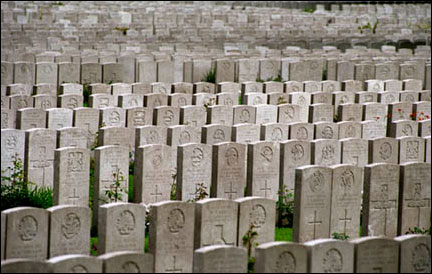
Lijssenthoek, Belgium: The Great War cemeteries
Thousands of miles, hundred of films, over one thousand scans from 250 locations and some of the worlds best and worst hotels and restaurants plus 85 gigabytes of files for my client. None of which would have been possible without the help of esteemed colleague Graham Trott who lent me his manual focus 18mm Nikkor lens to replace my own lens which I decided to re design by gouging out a chunk of glass from the front element after falling 18 feet from half way up a cross of sacrifice.
I am proud of Remembered, I believe the whole product, the writing by Julie Summers, the use of archival photographs and the space afforded to my images over 150 pages is a fitting testimonial to the memory of the fallen.
Their name liveth for evermore.
The book and exhibition, ‘Remembered’, will be officially launched at Canada House in London on the 21 May 2007. Henry Allingham at 110 Britain’s oldest surviving WW1 Veteran will open the exhibition of photographs. The exhibition will be open weekdays until mid July. An additional exhibition of photographs will open at the Cloth Hall in Ypres, Belgium on July 6th.
| Remembered: text by Julie Summers; photographs by Brian Harris, and foreword by Ian Hislop. | Published by Merrell of London and New York to commemorate the 90th anniversary of the foundation of the Commonwealth War Graves Commission. ‘Beautiful and uplifting photographs by Brian Harris’, Andrew Marr, Start the Week, BBC Radio 4. ‘The immeasurable success of this ( Remembered Book ) can be viewed in Brian Harris’s sumptuous photos’, Robert Pike, The Walden Local. ‘A pictorial odyssey…evocative photographs’, Peter Davies, The Times ‘ Stunning images cast new light on nine decades of tireless effort in the name of remembrance’, The Royal British Legion Magazine. |