For us that meant a legal dispute that has taken over four years. During which there were meeting after meeting, filling in questionnaires, collating evidence, estimating loss, numerous email discussions and countless phone calls.
I had been working and supplying The Scotsman group for around ten years. I was one of a core group of photographers who did the same. We had a certain loyalty to the titles; although freelance we were probably ‘de facto’ staff, without the benefits. We were part of the furniture. We enjoyed the freedom of creativity offered by the picture editors. There was a playing for the jersey spirit about the titles, which encouraged a good-natured competitive element among the photographers. Our images were used well. We certainly weren’t working for the money, but were foolishly seduced by good picture use. We cared about pictures and felt they did too.
Rates and conditions were always discussed, change was always imminent. Promises were constantly broken. The reality though was that our goodwill was exploited routinely over the years. Shift and mileage rates hadn’t officially changed in almost 10 years.
Tea, biscuits and contracts
Then a breakthrough. October 2000 and a core group of regular freelance photographers were invited to meet Picture Editors and Management to discuss new shift rates and other things. On the table coffee, tea, with biscuits acting as a sweetener, for what followed. On one hand rates were to be increased and to be replaced by a new all-in fee. Repeat use fees in the same title were to be waived. Reproduction fees in other titles to be capped at a derisory level whatever the size. Further investigation of the all-in fee, meant no real difference to the individual as you were unable to charge actual mileage, parking, tolls, telephone calls. Then they gave us the contract. It didn’t take us long to stop eating their biscuits when that was introduced.
The Scotsman’s management stressed they just wanted to formalise the working relationship between us. However, what we were presented with was a blatant rights grab, which would have applied retrospectively, included mandatory syndication and contained a clause to indemnify Scotsman Publications if they misused our pictures! This contract bore no resemblance to the terms and conditions that had been commonplace over the previous ten years.
The Scotsman had let accountants draw up a legal document that attempted to grab our copyright. This was a big mistake. So was using a fundamentally flawed document as the starting point for a negotiation. So was refusing to admit their mistake. We were told that the contract was to come into effect on December 1 2001.
Why the rush after all this time to get freelancers to sign a contract?
With hindsight it is now clear that The Scotsman, and its other titles, were in the process of going online as well as looking to make the paper available via an American online newspaper vendor in a pdf type format. To make this deal work, The Scotsman had to ensure that it owned full copyright over the material it published.
Time for solidarity
Almost overnight, the Scottish Newspaper Association of Photographers (SNAP) was formed, a loose association of both NUJ and non-NUJ members, alerting photographers to any developments via email. Our campaign was about getting the message out and protecting our copyright. We spread the word south of the border through EPUK. We exposed the proposed copyright grab in the Trade press. We also informed our MPs and MSPs who put additional pressure on Scotsman Publications management. One MSP even raised our case in The Scottish Parliament. At all stages we attempted to keep the door open for talks with the management. In the end there were four different drafts of the contract, but every time they changed something in our favour they added extra conditions. The Copyright grab was ever present, but now dressed up as an all singing, all dancing licence that amounted to the same.
By the fourth draft of the contract we still felt that we could not sign. The Scotsman’s management announced that “If you won’t sign it then you won’t be working for us again.”
This in turn led to pre booked shifts being cancelled. Which as an aside resulted in a separate NUJ action against Scotsman Publications in which two of the photographers in the group successfully got paid for up to two months of cancelled work.
We felt that by effectively locking us out, The Scotsman had broken our existing – albeit unwritten – agreement. As a consequence, eleven of us wrote to the newspapers requesting that they no longer used the images we had supplied. These were images that each of us owned the copyright to, but we left copies of in the newspaper’s archive so that they could use them when they wanted to.
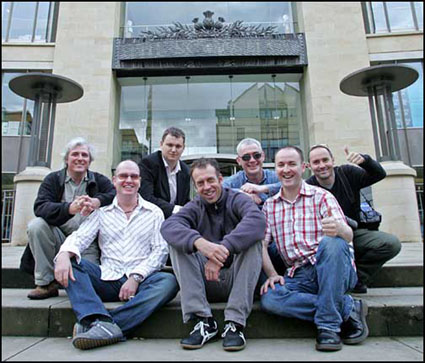
Seven of the eleven photographers involved in the successful court action, pictured outside The Scotsman Building in Edinburgh after the verdict. L-R: Graham McGirk, Paul Raeburn, Nick McGowan-Lowe, Colin McPherson, Gary Doak, Drew Farrell and Jeremy Sutton-Hibbert.
This is the incident that triggered legal action. We informed them that they not use any of our pictures held in their archive. Their reply was a legal one, from a lawyer who struggled to spell copyright (clue: it’s not two words, and the second one isn’t “write) and made it clear that Scotsman Publications would continue to use our pictures if required as per their ‘understanding’.
Boycott
SNAP – supported by the NUJ – then organized a boycott of the papers by photographers. At its height almost 200 photographers refused to supply Scotsman Publications on selected days, until they threw away the offensive contract and renegotiated it. Some of those have continued to support us throughout the last four years. However, we were under no illusion then that Scotsman Publications would always be able to get a paper out, we only sought to highlight the valuable contribution of freelancers. The staffers on the papers had days off cancelled and had to work evenings.
They hadn’t quite secured a big enough pool of photographers to sign away their rights. The handful that did sign did so under pressure. Some were told falsely that colleagues had already signed. Others told they could work without a byline. Promised work, some were allowed to work without signing anything in order to weaken the dispute. Students were offered job experience, a foot on the ladder and “…. if you can sign this first please.” I understand that the picture desks were put under an enormous amount of pressure to get people signed up which must have been difficult at times.
The last thing we wanted to do in the dispute was to personalise it, our gripe was with the management style and not with the desks. The desks had an understanding and respect for copyright, whereas the bean counters only had a short-term aim.
I was impressed with the way a lot of photographers and agencies managed to put aside their own rivalry and didn’t supply for those few weeks. Equally, others who saw it as an opportunity disappointed me – one in fact is a longtime NUJ member who decided to continue to supply as the dispute could not be called an official Union dispute. (The NUJ could not call it official, as it would have been viewed as secondary action to support the freelance action). However, he used our misfortune to line his pockets and settle an old score to spite his local competitor.
The Scotsman employed six photographers very soon after that. Strange how they couldn’t find a few grand to cover the cost of keeping us onboard and yet at the same time must have spent £300,000 plus overnight in wages, pensions, digital cameras/ lenses and cars. Given that the trend elsewhere to reduce staff and hire freelance, I think that was more a calculated political decision rather that a financial calculation. (Soon after that, they started to lay off staff photographers, including those they had just recruited.)
During this period both parties disputing rights over the archive exchanged a number of legal letters. It was also during that time that we became aware of the various web abuses. They had been using our pictures on their three online versions of the newspaper before archiving it on their flagship Scotsman.com site without permission.
SNAP and the NUJ
Although unable to make the dispute official the NUJ set up a hardship fund. One of the group highlighted the dispute at the ADM in Scarborough received an ovation from the floor and a bucketful of welcome donations. It was an amazing gesture and helped those who lost their income overnight. Our case was also heard at the Creators Rights Alliance meeting at the National Film Theatre in April 2001.
I think we were also reassured as a group of the NUJ commitment at our first meeting in their Glasgow office which was attended by the then General Sec. John Foster. More coffee, tea and biscuits on offer but unconditional on this occasion. His personal interest was proof that London would be watching.
Legal action begins
We decided to challenge Scotsman Publications use of our images on the web. Eleven of us set about logging any breaches. We set a target of 100, but found almost double that number. The abuses we found were, we reckon, the tip of the iceberg, as the dispute pre-dates broadband, finding possible infringements and taking screen grabs proved a tedious pastime with a dial-up connection. The online archive was difficult to search. Our images were removed from the websites sometime in 2001. Importantly, we had our evidence.
Our action was raised in part as a device to get Scotsman Publications to reconsider the take it or leave it contract and protect our archive from being undervalued. What followed though was a four-year legal ping-pong match. The highlights included filling in questionnaires, collating evidence, estimating loss. It was all a great deal less interesting than TV legal dramas. There followed a series of meetings, which were repetitive. At times there seemed little or no progress from the previous time and not a biscuit in sight. The preamble in the legal process was frustrating; the only consolation being it must have been the same for the other side.
If it weren’t for the encouragement from the other ten I guess it would have been easy to let it slip. Fortunately, as some of us were loosing the will to live, others remained focused and resolute. That was a huge strength of being part of a class action. Having that mini support network, having a rant down the phone or being able to fire off an email helped us keep it together.
It is funny, but I made the decision very early with my other non-editorial clients to let them know about the dispute. I was unsure how they would react, if I were doing the right thing by volunteering information. I needn’t have worried, in a strange sort of way they could identify with me, as in the past they had themselves been stiffed by newspapers, without any recourse.
My colleagues involved in the court action are among some of the most talented editorial photographers around, a well-traveled bunch who have a wealth of experience with a CV full of international clients. They weren’t automatons who would wait to be spoon fed by picture editors, but experienced individuals who would pitch their own ideas and stories. It has been a pleasure to be associated with them during this time.
Our fight wasn’t about personalities and it wasn’t even anti-The Scotsman. It was pro-copyright. It just so happened The Scotsman got there first. However, it could have been any number of other newspaper groups or publishing houses that have been issuing copyright grabs.
Settlement
Our case was settled on the eve of the Court of Session date in Edinburgh. The Scotsman offered no evidence in their defence nor did they provide any witnesses. In the eyes of their lawyers we had proved a genuine loss. They paid 100 GBP for unauthorized print use and more importantly agreed to pay 500 GBP pro rata per annum for the use of an image across their websites. Although there was no day in court the action against The Scotsman case is now a lodged public record and as we refused to sign a confidentiality clause we are able to show the outcome.
The case involved 133 copyright abuses in the print editions of the newspapers and magazines, and 52 copyright abuses in the online versions of the newspapers amounting to £33,488 including VAT. Of this, £4,794 had already been paid by Scotsman Publications in respect of the print abuses, but this was deemed unacceptable as a settlement by the eleven photographers. The dispute is estimated to have cost Scotsman Publications in excess of £170,000.
At the time of the first contract the NUJ were not welcome at The Scotsman. They were not allowed in the building. However a recognition vote among staff on those papers was overwhelming and since then the NUJ have helped secure improved terms and conditions for staff members. If something similar happened in the future, there could be more pressure applied by NUJ members from within the walls of Barclay House – the paper’s headquarters.
Currently, Scotsman Publications continue to operate a two-tier approach to photographers. Some must sign before they are able to work and others have never been told about the contract. Speaking of which, we were told in April 2001 that if we signed, it would be reviewed 6 months later, surprise no such review has ever taken place.
It would be refreshing if Scotsman Publications could engage with the NUJ to come up with a proposal to treat all photographers equally and respect the spirit of the Copyright Act 1988. I would have to grit my teeth, but I, and others, would still sit down and try to thrash out an equitable contract for photographers contributing to those papers.
Lessons learned
Other lessons learned from this dispute. Try and create a paper trail between yourself and the client, make sure they are aware of your terms and conditions. At least then you have a clear set of guidelines in place if that relationship breaks down. In our case our photographs were reproduced on the web. Take a screenshot of the abuse and do so at regular intervals of time (every month) if possible to build up your evidence. It’ll be up to you to collect and collate your evidence not your Union organiser. If you do not have any hard copies then you may not have a case. The burden of proof is on the pursuer. You must be able to prove loss. You will be responsible for doing the donkeywork, so the case will only proceed if you do your bit.
A personal thanks for their continued help and advice should go to the following, the ubiquitous Scottish Organiser Paul Holleran and the invaluable Tim Dawson (Freelance Industrial Chair), who helped steer the group in the early stages. And, of course, our colleagues here at EPUK who helped spread the word and support us both on and off-list. Finally, the NUJ for making available the necessary resources to protect our copyright.
This article originally appeared in the NUJ house journal “The Journalist”. Yes, that’s the same one which two months later ran a two page spread by activist Chris Wheal, arguing that copyright law needed to be abolished .Nothing like a joined up editorial policy, huh ?