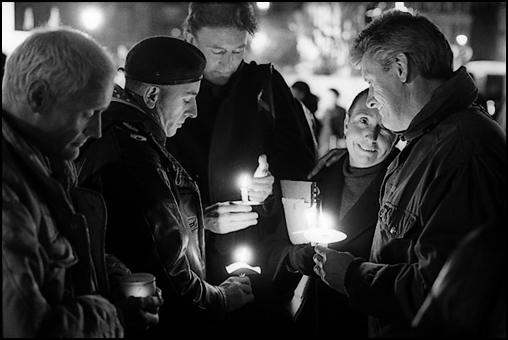

I chose this photo because today I heard on the news that young people are not getting the message about AIDS/HIV.
After 25 years, more people than ever are becoming infected in the UK and the majority are heterosexual.
Between 1994 and 1999 I worked frequently for London Lighthouse (now part of the Terence Higgins Trust), the West London HIV/AIDS charity, hospice and care centre. For reasons of confidentiality and sometimes fear of stigma or attack, few of the photos could ever be used outside Lighthouse’s own internal publications.
This particular photo was as candid a grab shot as I could manage at 1/4sec on a monopod. They were a small group present at a remembrance vigil – a few individuals among hundreds. I wasn’t sure whether they were aware of me or not, but I had no wish to disturb them. Lighthouse felt the photo intruded on a sensitive private moment and it could not be used. For me, it was the intimacy that was special, and it had been taken in a very public place, so we had a dilemma. Fortunately someone in the press office recognised one of the group and it turned out they loved the photo and asked for prints. They were delighted for it to be published to support the campaign for public awareness and felt it honoured their friend. That took some courage on their part, without which, this image would have stayed on the contact sheet.
That was in 1996. By 1999 a couple of things had changed. The first of the AZT-based drug regimes were beginning to be used to treat symptoms and prolong lives. Also the infection rate among gay men had fallen greatly thanks to the intensive educational effort, and of course widespread bereavement had pressed the message home. Yet HIV/AIDS was increasing among heterosexuals. Lighthouse was struggling to finance a unit for babies and children to meet the demand, especially among infected immigrant mothers. The local Hammersmith hospital, coincidentally where my own children had been born, was reporting a 5% HIV positive birth-rate.
Then along came Andrew Neil and the Sunday Times, accusing the largely-gay management of hyping the risks posed by HIV/AIDS when gay infection rates were falling. The job had been done, allegedly AIDS was now in retreat.
This was just what Government and sponsors needed to hear to justify withdrawal of much of the funding. Within weeks, Lighthouse was struggling to maintain services, and the children’s unit took several more years to get built. AIDS/HIV was pushed onto the back burner, with little budget for preventive education (or photographers). And the public as a whole now believes it only affects homosexuals, immigrants, haemophliacs and drug-addicts, and that combination drugs are almost as good as a cure.
So that’s the connection between this photo and today, and why in 2007 some 8,000 more people in the UK will personally find AIDS/HIV is unfortunately far from cured, that the global epidemic continues here as well as in hot, poor, far-away places. And about another 2,500 will be HIV positive and have no idea. And lots more sad friends and relatives will huddle together in little groups like this.

At the age of 8, Tony accidentally took a good photo and has been trying to do it again ever since. A challenge he feels has been quite difficult and expensive.
To Tony, school was an unhappy convergence of Stalag luft II and Lindsay Anderson’s ‘If’ (minus the machine gun).
He spent much of his early 20’s looking out the work’s toilet window and wondering how he could avoid the IT management career he was hurtling toward. Eventually he left and did freelance computer operating for 2yrs. This was the best-paid period of his entire life.
He then segwayed into building work, colour lab work, removals and helped run an alternative work agency. A removals partnership followed, then more building work, followed by youth work. Eventually after 10 years of this nonsense, he finally recognised that pro photography was inevitable. He had done some social documentary photography and occasional freelance photography jobs during this time.
Today, Tony almost always works on commission; reportage, informal portraits, places, events, people. His clients are generally charities, housing associations, PR, design companies or magazines. He also writes features occasionally. Regrettably most magazine work is now untenable thanks to the frozen 1990’s rates and un-negotiable copyright grabs.
Tony has been involved with EPUK from its beginning in 1999.
Photographer since 1980, EPUK member since 1999.
See more work by Tony Sleep