Interview by Si Barber
Vince, you visited Donbas in 2017, when the area was being contested by Ukraine forces & Russian paramilitaries. At that time, beyond the headlines, coverage of the conflict was hard to find in the UK press and your work, which foreshadowed the ferocity of 2022 invasion particularly in the death toll of civilians seems like a warning to the world. How were your images received?
I submitted those images to various publications and agencies, which generated a lot of interest, particularly in the personal stories of some of the subjects. However, it was challenging to get much published. Some of the images did appear here and there to illustrate aspects of the war, but unfortunately without the accompanying personal stories, which is what the series was all about. Although last year FotoEvidence published ‘Ukraine: Love + War’ and included the picture of Svetlana and her dogs, along with the story of how her home in Popasna had been hit by several Grad rockets fifteen minutes after the end of a ceasefire, as she was sleeping.
Someone from an NGO I had shown the pictures to had recognised her from a previous visit and offered her cash to pay for materials and labour for the reconstruction of the house, but she was unable to find builders to do it. Others I met were in the same predicament, where building supplies were stacked up outside the house, but there was nobody available to do the work.
I believe your journey to Eastern Ukraine was self-assigned, rather than commissioned. Given the state of the editorial market, is it possible to see a financial return on such work. If not, can you explain your motivation to take on such a challenging assignment?
I had been following the events leading up to the ‘Maidan Revolution’ in 2014, but the GIFS fishing project I was involved in and other commitments meant I couldn’t get away. As you mentioned earlier, the coverage of the conflict seemed to have stalled, so I thought it was the right time to make the journey. Even though you haven’t been commissioned and the likelihood of a financial return is minimal, it doesn’t stop the compulsion to touch the humanity of those affected by the tragedy of it all, and share their stories.
A quote by Philip Jones Griffiths from an interview about his book Vietnam Inc. has always resonated with me - “The single biggest mistake that a photographer can make is to believe in the profession, to believe in magazines and newspapers. When that happens, you have already failed. One must work first and foremost to satisfy oneself.”Make of that what you will.
I had read several reports about neighbourhoods in the Donbas frontline towns being abandoned, apart from a few of the older residents, who either had nowhere else to go or simply refused to leave their homes. That’s what I found, with many suffering from stress-related illnesses and little or no medication. I met men and women in their 60s, 70s and 80s who had survived parts of their homes being destroyed by shelling but still refused to move. Their resilience was incredible, and the determination to retain their dignity, deeply humbling.
Russian forces have now captured all the places I went to. The infrastructure of these cities, towns and villages has been decimated in the process and largely reduced to ruins: Popasna, Luhanske,Pisky,Maryinka andAvdiivka.
Your career has spanned the technological shift within photography from analogue to digital. Whilst digital has its conveniences, in places such as the Donbas with fractured infrastructure and intermittent power supplies, charging batteries and operating laptops would seem to add an extra layer of complexity to the assignment. On a practical level how do you cope with this aspect of the job?
I was based in Kramatorsk, where power and water were generally stable despite occasional outages. It was around a two-hour drive to some of the frontline towns, depending on the state of the roads, and I was able to get back regularly to get things charged. Of course, it’s very different now.
An initial problem I had was getting an ATO (Anti Terrorist Operation) Press Pass, as without one, it would be difficult to get through the multitude of army checkpoints. While I had been granted media accreditation, they couldn’t get the press card machine to work, so I spent five frustrating days trudging back and forth to the army’s press office before it was fixed. Understandably, they had more important issues to deal with.
On a similar topic, digital offers you theoretically an infinite number of exposures and immediate access to the images, but when you were shooting film in your earlier career you were limited by how much of it you could physically carry around. Some photographers like David Bailey felt that such limitations made them better photographers as they never knew what they'd got before it got developed. Did the switch to digital change the way you shot work?
It made me look at the back of the camera far more than should be necessary, which I am continually telling myself not to do. There are obvious major advantages to shooting digitally, and I am constantly seduced by them. I may well go back to working with film, on the odd occasion, as there are certain aspects of it I miss. Personally, I think sometimes there are advantages of a delay in seeing the images, as it can push you into another direction that you might not have taken.
I feel fortunate to have had those years of experience working with film, and I think you can adopt a workflow that accommodates the old ‘limitations’, if that’s what works for you, and enjoy the best of both worlds.
The one thing I don’t miss is trying to stop my films from going through the X-ray machines at airports and having them hand-searched instead. I returned from East Timor with 120 rolls of film, with images that had been particularly difficult to get, that had been through more X-rays than I felt was healthy. Fortunately, they were OK, but it was a tense few hours waiting for them to emerge from the lab.
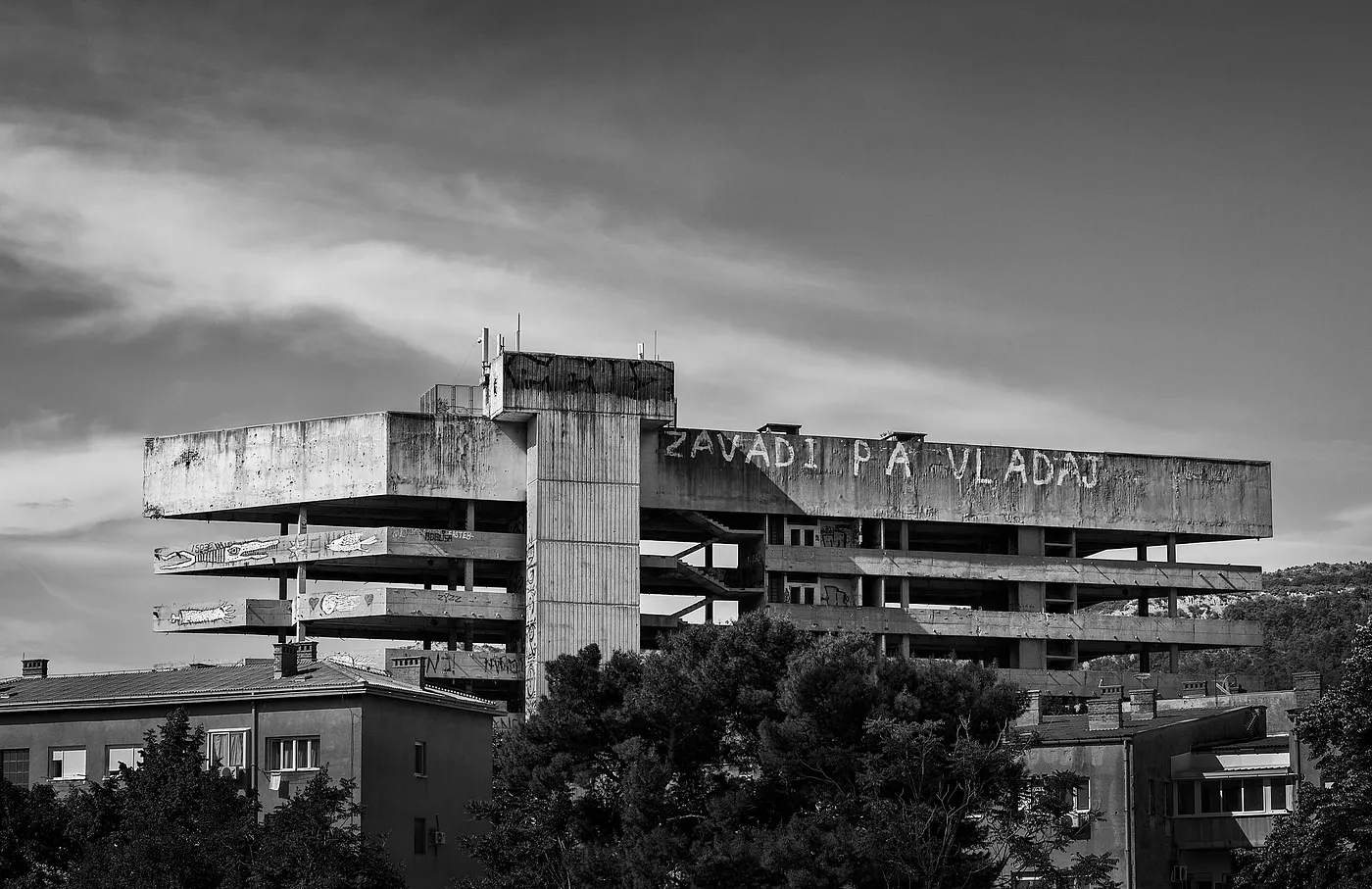
Also, in your early career in you went to Mostar, in the Federation of Bosnia and Herzegovina to cover the Croat-Bosniak conflict, part of the wider Bosnian war. Then the city was under siege with snipers making daily life for civilians extremely hazardous. Subsequently, in 2024 you returned and photographed those same sites previously inhabited by combatants from either side. How do you feel about places like the Ljubljanska Banka Tower, aka Sniper Tower having been the sites of war crimes now becoming tourist destinations?
People visit these sites for various reasons: curiosity, reflection on tragedy, or a desire to understand the past. I imagine anyone visiting the ‘Museum of War and Genocide Victims’ in Mostar, which displays the most heartbreaking material, would be subsequently drawn towards the Tower. The brutal wars of the 1990s in the former Yugoslavia should always be remembered, particularly considering the current underlying political tensions in the Balkans.
There has been a lot written about the division of Bosnian Croats and Bosnian Muslims in Mostar, which the war created. That division remains, and the Tower seems to be a constant reminder of it, particularly with ‘ZAVADI PA VLADAJ’, ‘Divide and Conquer’, emblazoned along the top of its exterior, which beams out on Mostar’s skyline. The local authority has tried to deter visitors from getting inside it by sealing the entry points, but ways in can still be found.
As I anticipated, returning in 2024 raised many questions and planted the seeds for other stories, which I’ll be looking into next year.
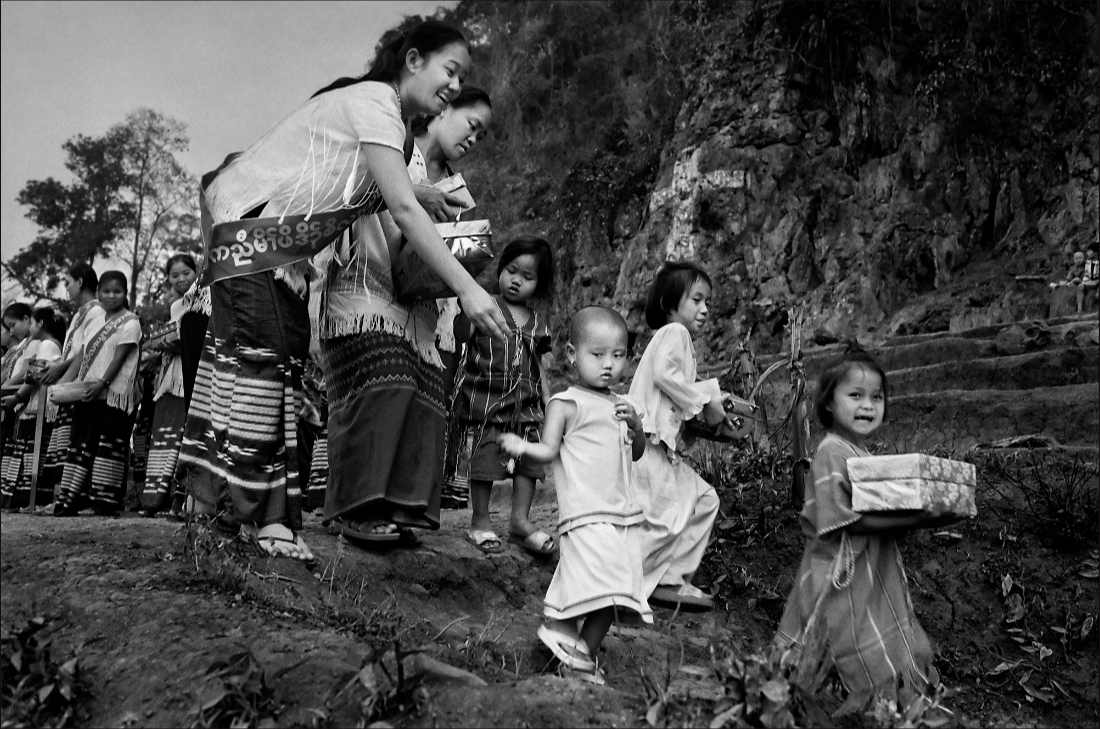
A theme in your conflict work seems to be the impact of war on the civilian population rather than the combatants, and in 2004, you used your images of the Karen to raise funds to improve access to water for refugees on the Thai-Burma border. Do you feel that photographers have a wider responsibility to improve the lives of their subjects rather than just be a witness to their plight?
I think any photographer would take the opportunity to improve the lives of their subjects, given the chance to do so, but it is not always possible, at least directly. I was fortunate to be given the chance on the Thai/Burma border. As with others, this work was self-assigned and funded through doing commercial projects, and while that allows a certain amount of freedom, it comes at a financial price. A little goes a long way in these places, and I have always given as much as I could afford. Of course, it’s never enough, and like others, I have felt a responsibility to do more, and the guilt when you don’t achieve it. At the end of the day, you do what you can.
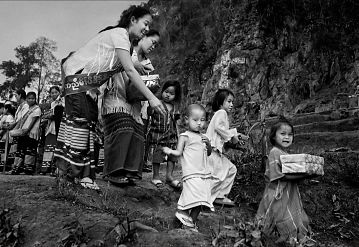
I had planned a deeper journey into Burma, but it didn’t work out that way. Instead, I divided my time between the Lep Per Her IDP (Internally Displaced Persons) camp, on the Burmese side of the Moei River and the Mae La refugee camp on the Thai side, producing pictures and collecting stories of various members of the Karen. During that time, the camp leaders of Lep Per Her asked me about the possibility of gaining funds for a new water system to replace the old bamboo one with new plastic pipes, to carry fresh water from its source, about a kilometre away.
Returning home, I did a couple of talks about the camps I visited and raffled off some prints. I printed a small portfolio of pictures from the trip and, with the help of my wife, sent them to people who we thought might support the fundraising efforts. We eventually raised just over £2,000, which was divided between Lep Per Her, the Kawthoolei Bible College in Mae La and the Free Burma Rangers, who do an incredible job supplying frontline humanitarian aid in Burma and other countries.
It was very satisfying to receive a set of colour prints showing the pipes being installed, along with a report on the work. Sadly, the camp was attacked again in June 2009 by the Burmese Army and the DKBA (Democratic Karen Buddhist Army), forcing approximately 3,300 people from the camp and the surrounding area across the border into Thailand.
You seem to shoot about half colour/monochrome. Is this purely an aesthetic choice or something deeper, and how receptive are clients to monochrome images?
I’ve always loved working in monochrome and the whole process of working on a print, either in the darkroom or digitally. Although some subjects and projects demand colour, so that’s the way you go, and I’m happy to work in both. Of course, the joy of digital is that you can shoot in colour and convert it afterwards, but I always have an eye on how it will look in b&w.
Interestingly, in the days when you did manage to get in front of a picture desk with your portfolio, everyone loved the monochrome stuff, but no one wanted to commission it. The same with photo agencies and libraries, it’s always the colour images that will sell more.
All the work for the GIFS project was commissioned and supplied in colour. A few years later, I converted a lot of those pictures into b&w, and after showing them around, the general opinion was that it gave the series a deeper perspective.
I have done photo workshops with schoolchildren and showed the same picture in colour and black and white. When I asked them about that picture the following week, most of them always remembered it as b&w.
Another theme in your work is intergenerational knowledge transfer, from Karen elders educating children in their own language to young lobster fishermen and Tex Woodward coaching young boxers. One of the long-term values of photojournalism is in recording precarious cultures and practices in a changing world. Have you made any arrangements for your work to be preserved for future generations?
Not yet, but I feel that there will be opportunities in the future to do so, at the right time. I already have work in the permanent collections of various museums, galleries, arts bodies and organisations, some of which were donated. Of course, while it would be better if they had been bought, having them on display has generated income and further interest in the story.
A selection of pictures from the Newlyn: Fishing for a Living project was donated to Penlee House Gallery and Museum, in Penzance, as one of the conditions for receiving a grant from Arts Council England. The GIFS fishing pictures are now permanently placed with the Greenwich Maritime Centre (associated with the University of Greenwich, which commissioned them).
Another picture I donated, produced in East Timor in 1999, is on display in the Balibó Veterans Museum in Timor-Leste, which maintains a permanent memorial to the five journalists murdered at Balibó in 1975.
Amid the 'democratizing' flood of citizen journalism and AI-generated visuals, your GIFS commission relied on research and fieldwork. Lugging gear onto pitching trawlers or waiting for the tidal light at Oostduinkerke seems to conjure an alchemy that cannot be reproduced by the casual onlooker or an algorithm. Yet this authenticity comes at a financial price that fewer organisations seem to be willing to pay. Are you optimistic about the future of this kind of work.
I would like to say yes, although any organisation wanting to commission this kind of work will need to have a realistic budget and someone prepared to put in the time and huge effort that working on these projects requires, particularly in the fishing industry. It is frustrating to see work that has obviously been produced quickly, when you see the potential for something with more depth. Understandably, organisations are tied to budget constraints, but it also comes down to what purpose the work is intended to serve, and whether it ismoney well spent. Obviously, stronger pictures will have more shelf life and further uses.
For the GIFS commission, I produced pictures of ten fishing ports in England, France, Belgium and the Netherlands over a period of eighteen months. While I had a reasonable expenses budget, I knew it wouldn’t be enough to afford me the time needed in each port, so I converted my VW T4 into a campervan. I worked out of that, staying in campsites and the port's car parks, which kept costs down and allowed a lot more freedom. If I couldn’t hook up to a power source, I could still use the van’s leisure battery to run the laptop and charge batteries. I kept equipment to a minimum on the sea trips and learnt from working on the Newlyn project how to keep equipment dry and used a waterproof cover on the camera, when possible. Even though the weather might be good, there is always a lot of water flying around, including the odd fish.
While I had pre-arranged contacts in some of the ports, I had to find my own in others. Getting onto fishing boats and into shipyards, etc., can be difficult, but when it becomes known that you are staying in a van in the port’s car park, it gives more credibility to your commitment to the project and provides a little more access.
I put more time into the commission than was expected of me. In addition to the planned exhibitions, some of the work was used as the flagship display on the streets of Le Guilvinec in Brittany, as part of the annual Photo Festival, ‘L’Homme et la Mer’. They subsequently went on to be shown at the European Parliament in Strasbourg. I don’t think this would have happened if I hadn’t put in that extra effort.
Finally, what are you working on at the moment?
Among other things, I’m working on a long-term project on Wales, where I’m from. Having lived outside my country, on and off, for many years, I am now living right on the border, which is an interesting viewpoint to see it from. It’s a project I always knew I’d embark on eventually, and this seems to be the perfect time to do it. I’ve been producing more pictures this year, which I will expand on next year. Eventually, I intend to introduce an audiovisual element into it.
I’m also planning to update my Newlyn fishing work, especially the changes in the port since Brexit.
As mentioned, there is the potential revisit to Mostar, and always an eye on returning to Ukraine, if I can finance it.
See more work by Vince Bevan